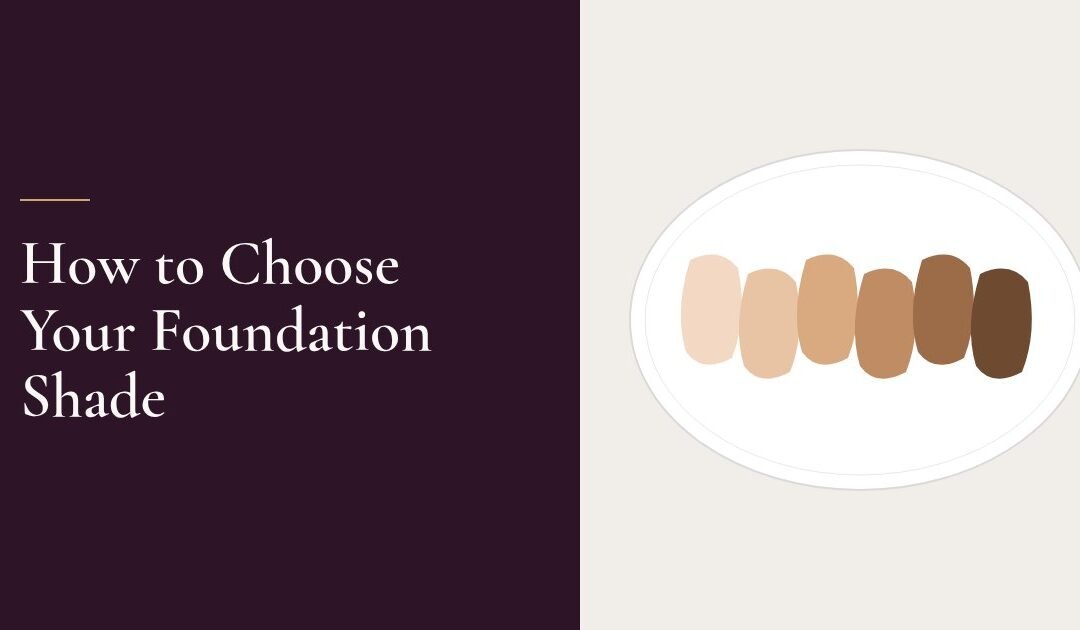
Choosing a foundation shade comes down to two separate decisions that people tend to collapse into one. Depth is how light or deep the shade is. Undertone is the direction of the color underneath, usually described as cool, warm, neutral or olive. Get the depth close and the undertone right and the shade disappears into your skin. Get the depth right and the undertone wrong and it reads gray, orange or ashy no matter how carefully you blend.
So the method for how to choose your foundation shade is: settle depth, settle undertone, pick a coverage level, then test on your own jawline in daylight. Here is each step.
How to choose your foundation shade in four steps
The four steps below run in order. Depth and undertone decide the shade, coverage decides the format, and the test decides whether you were right.
Step 1: Find your depth
Depth is the easier half. It is the straightforward light-to-deep scale that shade names and numbers mostly describe.
Two things to account for. First, depth changes through the year for a lot of people, so the shade that matches in February may sit pale in August. Second, your face and your neck are often not the same depth, and the neck is the one that matters, because the jawline is where a mismatch shows.
Match to your neck and jaw rather than the center of your face, and if you are between two depths, the slightly deeper of the two is generally the more forgiving choice.
Step 2: Find your undertone
Undertone does not change with the seasons. It is the consistent direction of color under the surface.
Three tests, none of which is definitive on its own. Use at least two and look for agreement.
- Fabric test. Hold a pure white cloth and then a cream or ivory one under your chin in daylight. If your skin looks fresher against the stark white, you probably lean cool. If cream flatters you more, you probably lean warm. If both look fine, neutral is likely.
- Jewelry test. Compare silver and gold against your skin, again in daylight. Silver tends to suit cool undertones and gold tends to suit warm, though plenty of people wear both happily, which is itself a neutral signal.
- Vein test. Look at the veins on the inside of your wrist in natural light. Bluer or more purple often indicates cool, greener often indicates warm. This one is the least reliable of the three, so never decide on it alone.
Olive is worth naming separately because it is frequently missed. If warm shades pull orange on you and cool shades pull pink, but you are not quite neutral either, you may read olive, which carries a green cast. Shades described as olive, neutral-olive or with a green base are the ones to try.
| Undertone | Usually reads as | Shade words to look for | Mismatch symptom |
|---|---|---|---|
| Cool | Pink, red or bluish | Cool, rose, porcelain, cocoa | Shade pulls orange |
| Warm | Yellow, peachy or golden | Warm, golden, honey, caramel | Shade pulls pink or gray |
| Neutral | Balanced, no strong pull | Neutral, natural, beige | Usually forgiving either way |
| Olive | Green or khaki cast | Olive, neutral-olive, sand | Shade pulls orange or ashy |
Step 3: Decide how much coverage you want
Coverage is about how much of your own skin shows through, and it is a preference rather than a correctness question. Pick the level that suits how you want to look, not the level a product category implies you should want.
| Coverage | What it does | Typical formats |
|---|---|---|
| Sheer | Evens the look of tone slightly, skin reads as skin | Tinted fluids, skin tints |
| Light | A visible but soft layer, texture still shows | Light liquids, cushions |
| Medium | More uniform finish, buildable in places | Most liquid foundations |
| Full | Highly uniform surface, very little shows through | Long-wear liquids, sticks |
Finish is a separate choice from coverage. Matte, natural and radiant finishes exist at every coverage level, and finish has more effect on how a foundation looks in photographs than coverage does.
One honest note: a shade match is harder to hide at higher coverage. A sheer tint forgives being a touch off. A full-coverage foundation does not.
Step 4: Test it properly
The testing method matters more than any shade chart.
- Start on clean, bare skin. No existing base on your face, no moisturizer that has not settled.
- Swatch on the jawline, not the back of your hand. Your hand is almost never the same depth or undertone as your face.
- Swatch two or three candidates side by side. Comparison is much easier than judgment in isolation.
- Blend each one out properly. An unblended stripe tells you very little.
- Wait fifteen to twenty minutes. Many foundations shift slightly as they dry and interact with your skin’s own oils, which is the effect usually called oxidation. The shade you see at minute one is not always the shade you wear at hour three.
- Then go to a window. Look at it in daylight, facing the light, then with the light behind you.
- Check the jaw and neck boundary. If you cannot see where the product stops, you have your shade.
Why the same foundation looks different in different light
This is not your imagination, and it is not a faulty product.
Light sources have different color temperatures. Daylight is relatively neutral and even. Household bulbs are typically much warmer, which pushes a base to look more yellow or orange. Many shop and office lights are cooler and flatter, which can make the same shade look ashy or gray. Fluorescent and LED lighting also render some pigment combinations oddly, so two shades that look identical under one light can look visibly different under another.
The practical response is to choose your shade in daylight, because that is the light you cannot control and the one most people see you in. Then accept that bathroom-bulb lighting at 7am is a poor place to judge anything.
How to choose your foundation shade when you are buying online
Ordering without a counter swatch is a reasonable estimate rather than a certainty. Match the depth to your neck, match the undertone to whatever your two tests agreed on, and expect to learn something from the first bottle. Most people land it on the second attempt rather than the first, so plan for that rather than being annoyed by it.
A few habits that keep the cost of that down.
- Buy one foundation, not three, until you know the formula suits you.
- If your depth shifts between seasons, two shades a step apart, mixed in varying ratios, covers the year better than four exact shades.
- Keep the product’s shade name or number written down. Shade naming is inconsistent between ranges, and your own note is more useful than any conversion chart.
- Apply with the tool you will keep using. A brush, a sponge and bare fingers each deposit different amounts, so a test applied one way and worn another can read as a mismatch when it is actually an application difference.
One plain note on skin
Makeup is cosmetic, and that is all it is. Anything persistent, painful, spreading or changing in appearance is a matter for a doctor or a board-certified dermatologist, not for a shade change, and if a product causes a reaction, stop using it and have it looked at. We sell cosmetics and do not offer medical guidance.
The summary
Depth to your neck. Undertone from two agreeing tests. Coverage to your preference. Swatch on the jawline, wait twenty minutes, judge it in daylight. That sequence is the whole method, and it works whether you are standing at a counter or ordering at home.
When you are ready to compare shades and finishes, browse the Makeup collection and start with the undertone family your tests pointed to.